
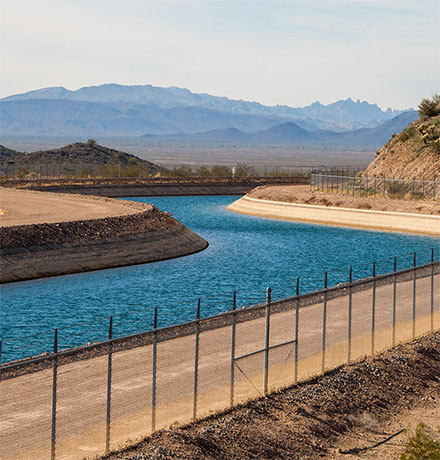

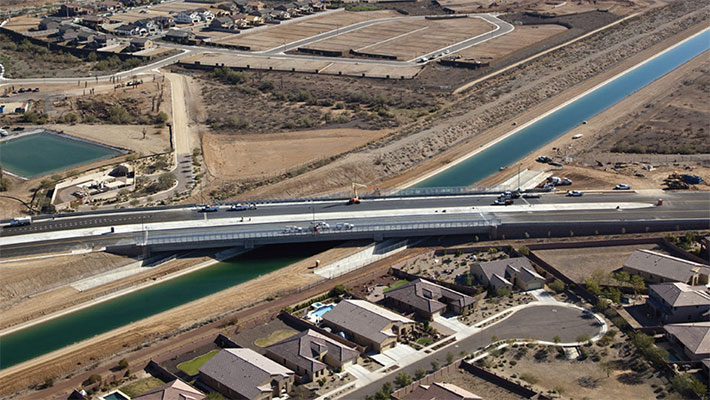
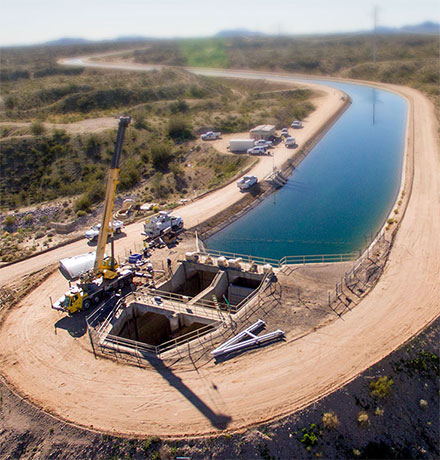
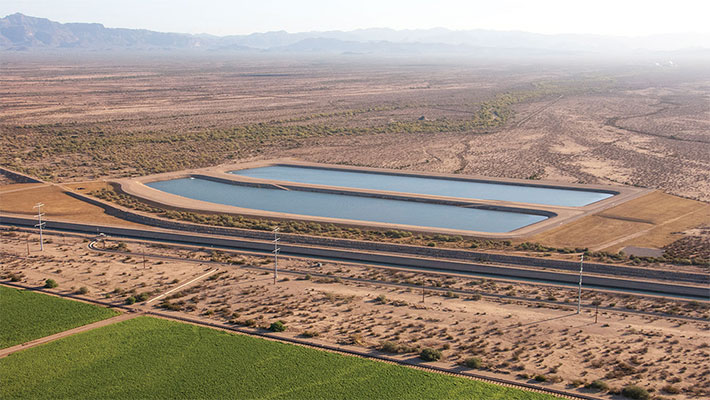

CAWCD has developed and currently operates six recharge projects with one additional project under development that has an expected completion date in 2011. The Tucson Active Management Area (AMA) recharge facilities have a cumulative permitted capacity of 91,000 acre-feet per year and include the Avra Valley, Pima Mine Road and Lower Santa Cruz Recharge Projects. In the Phoenix AMA, there are three existing facilities; the Agua Fria, Hieroglyphic Mountains and Tonopah Desert Recharge Projects, with a combined annual permitted capacity of 285,000 acre-feet. The project under development in the Phoenix AMA is the Superstition Mountains Recharge Project. This project will add an additional 56,500 acre-feet of annual recharge capacity. For a detailed description and photographs of each of the recharge facilities, go to each of their listings on the left-side menu.
| PERMITTED RECHARGE CAPACITY | |||
| Project Name | Year Complete | Permitted Capacity | Cumulative Capacity |
| Avra Valley | 1996-97 | 11,000 | 11,000 |
| Pima Mina Road | 1998-99 | 30,000 | 41,000 |
| Lower Santa Cruz | 2000 | 50,000 | 91,000 |
| Agua Fria | 2001 | 100,000 | 191,000 |
| Hieroglyphic Mountains | 2002 | 35,000 | 226,000 |
| Tonopah Desert | 2006 | 150,000 | 376,000 |
Recharge Program Goals
Artificial groundwater recharge plays a critical role in the Central Arizona Water Conservation District (CAWCD) mission …"to deliver the full allocation of Colorado River water to central Arizona in a reliable, cost effective and environmentally sound manner". Recharge is a long-established and effective water management tool that allows renewable surface water supplies, such as Colorado River water, to be stored underground now for recovery later during periods of reduced water supply.
In 1996, CAWCD completed its first recharge project in the Avra Valley located northwest of Tucson. The CAWCD Recharge Program has since expanded to include six operating projects within CAWCD's service area. With the rapid expansion of CAWCD's Recharge Program, Arizona is now able to divert and put to use its full allocation of Colorado River water each year.
CAWCD's Recharge Program was established with the principal goal of protecting the economy and welfare of the State of Arizona by managing the reliability of its most valuable resource …water. The water management benefits of recharge are numerous and include the following:
Authority for CAWCD Recharge Program
State legislation was adopted in 1971 that authorized the formation of the CAWCD to repay the federal government for the construction cost of the CAP, contract for delivery of Colorado River water and operate and maintain the CAP aqueduct. Subsequent statutory authority to conduct recharge activities was added to CAWCD's roles and responsibilities by the Arizona legislature beginning in the mid-1980's to include:
| Year | Authority Granted To CAWCD |
| 1986 | Authority to conduct feasibility studies for groundwater recharge and recovery projects. |
| 1987 | Authority to conduct underground storage and recovery activities |
| 1991 | Authority to acquire, develop, construct, operate and maintain State Demonstration Recharge Projects for underground storage of CAP water; creation of the State Water Storage Fund and authority to levy a property tax to develop State Demonstration Recharge Projects |
| 1993 | Authority to form and operate the Central Arizona Groundwater Replenishment District (CAGRD) |
| 1996 | Authority to dedicate funds from the State Water Storage Fund to the Arizona Water Banking Authority (AWBA). |
| 2000 | Authority to acquire real property for development of State Demonstration Recharge Projects through eminent domain. |
CAWCD Recharge Program History
Soon after receiving authority in 1986 to conduct recharge feasibility studies, CAWCD implemented two studies to identify favorable locations to develop recharge projects along the CAP aqueduct. Opportunities for Groundwater Recharge in Central Arizona, 1987, was a reconnaissance level feasibility study report that identified potential recharge sites along the entire length of the CAP between the Colorado River and Tucson. Butler Valley Underground Storage and Recovery Project, 1987, was a site-specific investigation report to assess the hydrologic feasibility of constructing a large-scale recharge project in the Butler Valley, an alluvial basin located in western Arizona. Although these studies investigated numerous potentially favorable sites, they did not result in development of a project.
In the early 1990's, CAWCD recharge efforts primarily focused on development of Groundwater Savings Facilities (GSF) also know as "in-lieu" or "indirect" recharge as a means of encouraging the direct use of CAP water instead of continued over-reliance on groundwater supplies. In general terms, a GSF is a water exchange authorized under State law where the operator of the GSF (typically an irrigation district) will substitute renewable surface water (CAP water) for groundwater that it has a legal right to pump. This substitution of surface water for groundwater essentially "saves" groundwater that would have been pumped and is legally considered analogous to direct recharge. The customer storing at a GSF receives long-term storage credits that can later be recovered and not counted as groundwater pumping.
Beginning in 1992, CAWCD acquired the necessary regulatory permits from the Arizona Department of Water Resources (ADWR) and entered into agreements with eleven different irrigation districts to deliver excess CAP water for agricultural irrigation in-lieu of pumping groundwater. In return, CAWCD earned long-term storage credits that can be recovered during future water supply shortages. Under this program between 1992 and 1999, CAWCD accrued approximately 645,000 acre-feet of long-term storage credits in its three-county service area.
In 1990, legislation passed authorizing CAWCD to develop State Demonstration Recharge Projects and established the State Water Storage Fund to finance development of these projects with revenues derived from a property tax collected in Pima and Maricopa Counties. The purpose of the State Demonstration Project statutes was to allow for construction of permanent, large-scale underground storage facilities for direct recharge of excess CAP water. These facilities provide a means of storing excess CAP water not currently used by CAP subcontractors for future recovery during periods of severe water shortages. State Demonstration Projects are also used for replenishment purposes by the CAGRD. Additionally, cities and private water companies utilize these projects for compliance with the State Assured Water Supply requirement. Finally, the Arizona Water Banking Authority (AWBA) stores water at State Demonstration Projects to firm the water supply of CAP municipal and industrial subcontractors against future shortages and for interstate water banking purposes.
Property taxes collected between 1991-1996, along with interest revenue, resulted in $33.7 million for the benefit of Maricopa County and $8.5 million for Pima County State Demonstration Projects. With the formation of the AWBA in 1996, CAWCD annually determines whether to direct revenues from the property tax to the AWBA to fund groundwater recharge and other AWBA activities. All property tax revenue collected since 1997 has been directed to the AWBA.