Colorado River Operations
Home > Water > Water Supply > Colorado River Operations
Colorado River Operations
The Colorado River Basin continues to experience drought exacerbated by the impacts of climate change. Arizona has worked together to ensure stability for Colorado River system supplies currently, in the near-term and in the long-term.
- Post-2026 Operations – The current guidelines expire in 2026. Arizona continues to work with states across the Colorado River Basin to develop concepts for operating a sustainable river system.
- Short-term solution (through 2026) – Reclamation featured the Lower Basin states’ May 2023 proposal as the preferred alternative in its Final Supplemental Environmental Impact Statement for Near-Term Colorado River Operations. This will conserve three million acre-feet of Colorado River water by 2026, beyond reductions from the 2007 Shortage-Sharing Guidelines and the Drought Contingency Plan.
- Current conditions – The Colorado River Basin is in a Tier 1 shortage for 2024.
Post-2026 Operations
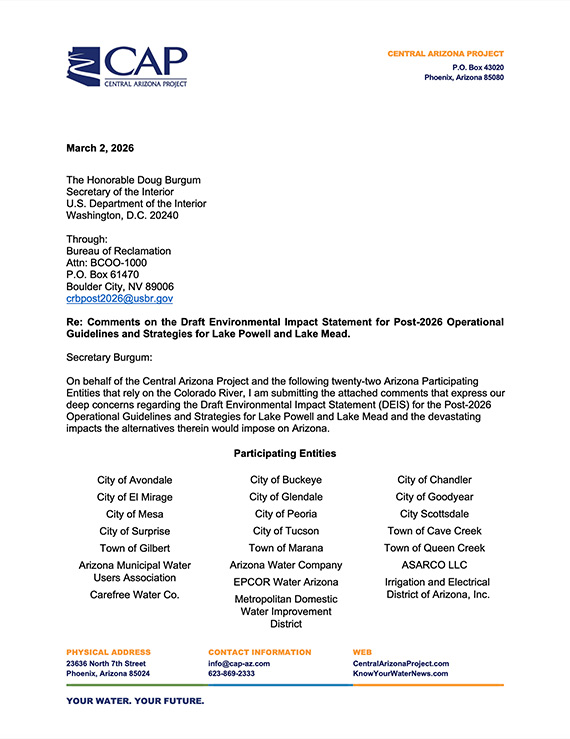
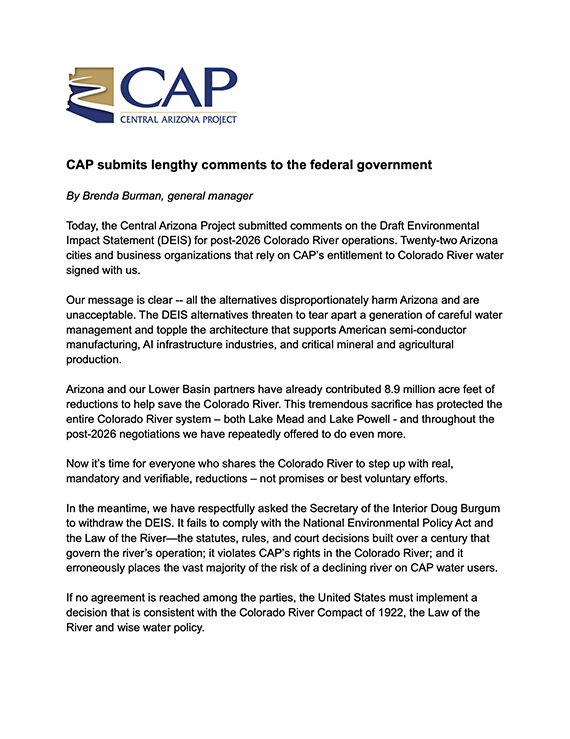
The current 2007 Shortage-Sharing Guidelines and Drought Contingency Plan expire at the end of 2026. The federal government issued a Draft Environmental Impact Statement (DEIS) regarding post-2026 operations on Jan. 9, 2026 with comments due on March 2, 2026.
To the right and below are links to CAP’s DEIS comments, statement and related documents.
Related documents:
- Lower Basin States’ Alternative FAQ (April 2024)
- Press Release: Lower Basin Proposes New Colorado River Approach (March 2024)
- Lower Basin Alternative Letter Submittal (March 2024)
- Bureau of Reclamation: Post-2026 Colorado River Operations
- CAWCD, SNWA, Metropolitan joint letter in support of Lower Basin Alternative
Short-Term Solution (through 2026)
Former Bureau of Reclamation Commissioner Camille Touton testified before the Senate Committee on Energy and Natural Resources in June 2022, acknowledging that the effects of drought and climate change have been unlike anything we’ve seen in our history. Touton stated that in addition to the actions already prescribed under the 2007 Interim Guidelines and the Drought Contingency Plan, an additional 2 to 4 million acre-feet (MAF) of conservation would be needed through the end of 2026 just to protect the critical levels in the major reservoirs, allowing for power generation and infrastructure stability. This kicked off a heightened sense of urgency to stabilize the system.
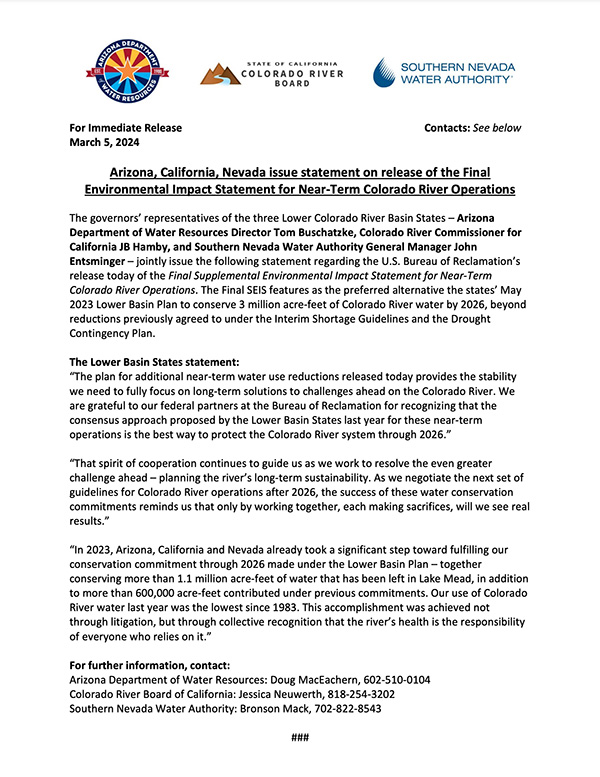
In March 2024, Reclamation released its Final Supplemental Environmental Impact Statement for Near-Term Colorado River Operations. This features as the preferred alternative, the Lower Basin states’ May 2023 proposal to conserve three million acre-feet of Colorado River by 2026, beyond reductions previously agreed to under the 2007 Interim Shortage Guidelines and the Drought Contingency Plan.
This is a testament to the Lake Mead conservation efforts that CAP, Arizona and the Lower Colorado River Basin have been committed to for the past decade, which have kept Lake Mead from reaching critical levels.
Related documents:
- Final Supplemental Environmental Impact Statement for Near-Term Colorado River Operations (March 2024)
- Arizona, California, Nevada press statement (March 2024)
- Six-States SEIS Response: Consensus-Based Modeling Alternative (January 2023)
- Joint ADWR/CAP Statement: Six States Meet Deadline with “Consensus-Based Modeling Alternative (January 2023)
- Colorado River States Submit a Consensus-Based Modeling Alternative to Bureau of Reclamation (January 2023)
- Joint ADWR/CAP Statement in response the U.S. Department of the Interior announcement regarding 2023 Operating Conditions for Lake Powell and Lake Mead (August 2022)
- Statement from CAP General Manager Ted Cooke in response to the announcement from the Bureau of Reclamation Commissioner Camille Touton regarding deteriorating conditions on the Colorado River system (June 2022)
Current Conditions
Arizona is currently taking Tier 1 reductions for 2025. This represents a 512,000 acre-foot reduction to Arizona’s Colorado River water supply, constituting 30% of CAP’s normal supply, about 18% of Arizona’s Colorado River supply, and just under 8% of Arizona’s total water use. Nearly all the reductions within Arizona have been taken by Central Arizona Project (CAP) water users. These reductions were determined by the CAP priority system – the result being less available Colorado River water for central Arizona agricultural users.
View our current Colorado River conditions dashboard for data updated at least twice monthly.
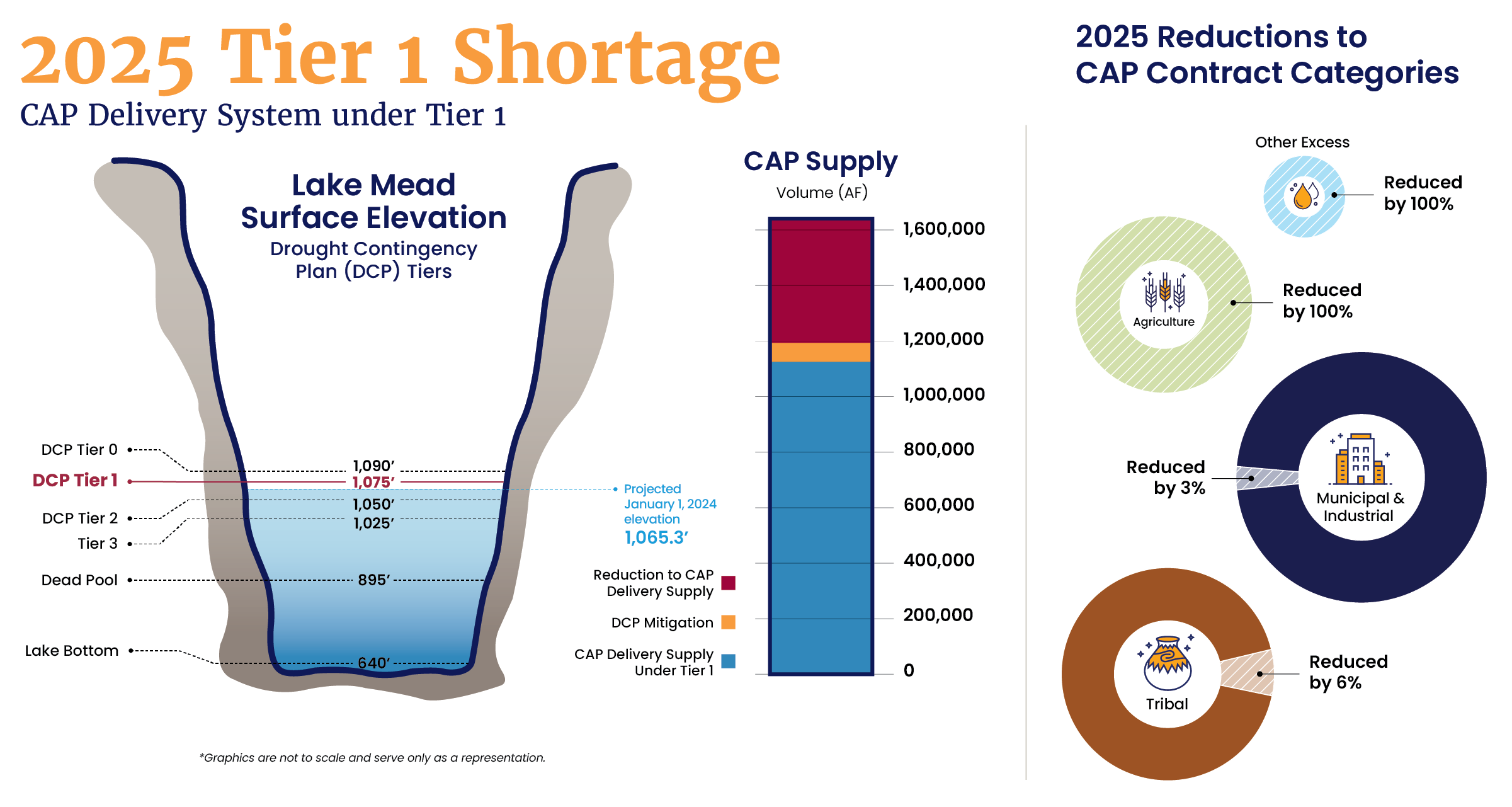
This graphic shows the reductions CAP is currently taking. Lake Mead is on the left. The CAP supply is in the middle, showing we have a little more than a million acre-feet available for delivery. And on the right-hand side, you see the total impact to excess water and agricultural supplies and the rather negligible impact to M&I and tribal supplies.
Related documents:
- Joint ADWR/CAP Arizona Republic Opinion Piece: Colorado River under stress – Arizona’s response (May 2022)
- Joint ADWR/CAP press release regarding the U.S. Secretary of the Interior’s declaration of a Tier 1 shortage on the Colorado River for 2022 (August 2021)
- Joint ADWR/CAP statement: April 24-Month Study (April 2021)
- Joint ADWR/CAP statement: Arizona’s shortage preparedness (2021)